Heading Message

A Pagan Gathering for Australia and the world

Showing posts with label Tradition. Show all posts

Monday, April 1, 2013

A Paganesque Moveable Feast - Abbots Bromley Horn Dance

A run-down of the pagan gatherings and pagan-like festivals from other parts of the world.

By Tania Poole

Abbots Bromley Horn Dance is believed to have been running since the Barthelmy Fair, granted to the Abbots of Burton by Henry III in 1226, celebrating Bartholomew’s Day – August 24th. The changing of the Julian Calender in 1752 has moved the Fair to the beginning of September, and the Fair became one day, rather than three days. Yet the horns have been dated to centuries before - the 11th century – and being reindeer antlers, they obviously came from Scandinavia, probably down the River Trent and into the Staffordshire region.

The Horn dance day is always held on a Monday – Here is how you remember which day it is on. It’s always ‘the Monday following the first Sunday after the fourth of September’ – remember that folks, many a person has turned up on the wrong Monday and been disappointed…..

So I managed to go to the Abbots Bromley Horn Dance. My friend Steve goes every year, and has done since 1989. So when I thought I could go, I emailed Steve about it, he told me he could not go, but told me how much it was going to cost me to go via public transport. It did not seem worth it, considering if I had to travel there myself, funds were low, and I had plane tickets to buy.  But then Steve changed his mind, saying he would be able to go and help me pay for my travel there. Suddenly that was it – I was going! I also have a new friend that I met only this year. Shamus, an accordion player who plays for the Black Pig Border Morris Team, and is also dating my friend Angela. Shamus has played accordion for the Horn Dancers for over 2 decades now! It's all about who you know!!! 


I met Steve at Wakefield station at 10am, and we made our way south to Derby, then to Uttoxeter where a cab driver was waiting for us – Steve books him every year, so he knows him personally. From there, the village was about a 15 – 20 min drive away.
In Abbots Bromley, you found yourself in a relatively untouched village – a typical Staffordshire village at that – with not much changed. Some of the buildings here still are certainly medieval. We were dropped off at the Buttercross – a hexagonal shaped building near the green that was used for market day over many centuries – I’ve seen one other like it in Bungay. This one is more medieval looking, the Bungay one looks Georgian. Someone there that day told me what a Buttercross was – at market, it was where people bought butter, milk and eggs.
We visited a pagan art stall – a longhaired, bearded attractive man named Chris Bell, selling his pagan art (mostly green men) in the market and I bought a few as gifts for people back home. After that we had our first pint at the Goat’s Head pub, and met some of Steve’s pagan friends there. Great chats with people I’d just met, who had good stories to tell. Even Steve had stories to tell about his annual jaunts to Abbots Bromley. As he’s been coming since 1989, he had a few tales, and I think, could write a book about the goings on that he had witnessed over the years – the pagan camps, the large and small crowds, the popularity of the event, and how they’ve evolved. One story he told was about how he and his pagan friends were sitting in the pub or somewhere and a tradesman came along and asked them about runes – he had seen some around the village – under the tiles of the old roofs and houses – dating back centuries, probably even the middle ages. They had been scratched into the architecture of the old buildings – some of these probably not repaired for many centuries. Sketching the runes for the pagans, the tradesman was told they may have been symbols of protection upon the house. Kind of reminds me of the concealed shoes superstition. Now THAT would be good article.
 
 
After our pint, we went to the old Church House – that is certainly medieval or even later, but definitely one of the oldest houses in the village. They put on a great spread there – sandwiches and cakes to eat, and endless tea – we had our lunch there – well, a small lunch, we also ate more later on.

The Old Church House where we had lunch
 
Steve took me to the St Nicholas Parish Church to see where the horns are kept. I could tell by looking at it, parts of it were Saxon, and like all Saxon churches, had been added to over the years, especially in the Norman times. Saxon and Norman buildings go together a lot here. This one was quite a lovely church. The bars that hang the horns up are there, and even the old hobby horse from years ago – I’ve seen old images from the 70’s of that hobby horse being ridden about the place – it says that the horse is from the Middle Ages – could it actually be that old? I often hold doubt of things like this – what looks medieval, could have been made as recently as the nineteenth century. They use a new one in the dance now. There were also glass cabinets holding the regalia and costumes of horn dancers past.
 
There was also a story from Steve about the pagans who actually came to church services in previous Horn dance weekends, in their velvet robes and pentacles, and sat in the front row, much to the annoyance of the vicar. The Christian locals preferred to sit up the back as far away from the pagans as possible. Would have loved to have seen that.
In the churchyard, the ground surrounding the church was raised, as if it was small pre-Christian mound. It makes us wonder if indeed a Saxon church was here, maybe something before it existed. Steve also showed me a headstone, belonging to a man that was once a leader of the horn dancers – and it says that on his headstone. He belonged to the Fowell family, and they are the official horn dancers – their family and another one are the only members that are allowed to dance, and have been for many, many generations.  Steve also told me about another friend of his and a visitor to the Horn Dance day would spend the night in the graveyard because he had nowhere else to sleep. And people and locals did not mind – he was just the ‘guy who slept in the graveyard.’ Oh Boy! The characters you get at these events.
We walked up the street to the Bagot Arms, passing some of the places where Steve says the dancers stop for a pint, or food. In the Bagot Arms, Steve and I had another pint and we chatted about many other things – pagans in the UK and Australia, folk dancing, horse brasses, and many other things that crossed our minds. I kept seeing more and more people walking past the pub window, as I realised the tourists were arriving. It was probably about 3.00 - 3.30pm by now, and the dancers were due to arrive in the village. After a toilet run, I went outside to find Steve standing there, prompting me along. As I looked west down the road, I saw the dancers skipping along the road with their horns. I got really excited here – this was it! I was finally going to see this horn dance. It all dawned on me where I was when I saw them. I began to not believe that I was here!
As they came along, they circled around each other, and I saw my Staffordshire friend Shamus playing the accordion, who acknowledged me and gave me a head bow. I began to take some short footage of the dance, and Angela, the leader of my border morris team back in Yorkshire, was in the background. She saw me and came around to give me a hug. After this dance the dancers went under an arch and out into the backyard of one of their friends who had put on a bit of food. Steve suggested we walk back into the village, and before we walked off, Ang invited us out the back with the dancers to hang out with Shamus. The four of us got some group photos together and then went further out the back to the lawn to watch some of the dancers dance with some locals. They are a more open folk dance than I thought. You think about Padstow and how only locals can go to the May Day Festival because the tourists ‘clogged the village.’ And the Morris Ring who have men-only sides who refuse to let women join, but here in Abbots Bromley, they let locals dance and WOMEN too! What a nice bunch of people! Not superstitious about a woman holding the horns let alone having a dance!
 

Me with Shamus and Angela, who is the
squire of my morris team


After that, we followed the dancers out to the street again and walked along as we watched them head to the Bagot Arms back towards the village. At this car park, Shamus dragged me over to where the horns were laid on the ground, and shoved a set of horns into my hands. I was holding the lighter horns that were damaged in the mid 70’s and the broken bit was dated to have been from around 1060s. I made sure veteran attendee Steve got to hold them as well.


me with some horns
Steven with the horns
We headed back towards the Buttercross, running into more pagan friends of Steve on the way and stopping for chats. At the Crown Pub, we went inside to see the new décor of the renovated pub – all modern and new, and saw the Horn Dance paintings done in the 1940s. Then we went round the back of the pub and visited the pagan camp site up the back – I saw Nick from the Black Pigs Border Morris and went to say hello to him by his hearse. Then we got a hotdog outside the front of the Crown and then stood with more of Steve’s friends, Cathy and Robin. It was now when the horn dancers had made their way down into the village and arrived outside the Goat’s Head and held up the traffic doing their road-hogging dance. Then they rested by the Goat’s Head and let friends dance with them.


I chatted to friends Ang, Fran, and Shamus, and Steve and his friends joined us. I visited the stalls again and bought some Horn Dancer pins. Then the dancers went out the back of the Goat’s Head and posed for photos. We stayed back there in the large beer garden until about 6pm, then headed back to the Crown. It was time for Steve and I to get back to the station, so we looked for our cab. I could not find Ang or Shamus at all, so never got to say goodbye. It was the last time I saw Shamus too. Our cab was waiting when it started to rain again. We got the train from Uttoxeter to Derby and then caught one home to Leeds - finally on our separate ways home, and with a few train cancellation issues, Steve and I made it safely home.
 
I had an awesome and memorable day at Abbots Bromley and am very glad I got to go. It was magic! And brilliant to witness such an old dance and finally see how it was conducted, especially since I have been going to folk dances all year. Getting to know so many people apart from Steve in England has been wonderful, meeting Shamus in March and becoming friends with him, and then learning that he was the accordion player for the Horn Dancers absolutely blew my mind! What are the chances of such a meeting! I had such a wonderful day!
Even now, after six months, I am still reeling from the experience. I had always dreamed of going, and never thought I actually would! Thanks to Steve Jones, Shamus O'Blivion, and Angela Boycott-Garnett.


Friday, March 2, 2012

A Paganesque Moveable Feast - The Marsden Imbolc Fire Festival (MIFF)

A run-down of the pagan gatherings and pagan-like festivals from other parts of the world.

As some of you know, just after our lovely Beltane at Mount Franklin 2011, I left the country to travel to the Uk to work for a year. Seeing I am observing many festivals while I am here, i thought I'd do a report on many of them. There seems to be so many amazingly organised events here in England and I have learned many things at these events that I plan to bring home.

I have had the fortune to live in Marsden since I arrived in the UK. I did not know about it beforehand, indeed it was just another village in west West Yorkshire to me, but since I have come here I have discovered just what village life is all about. There is an amazing sense of community here, a pagan-friendly, open-minded hamlet in the south-west end of the Colne Valley and its festivals are revered and maintained annually. Every year for 20 years now, there has been an Imbolc fire festival held here.

I also had to fortune of participating in this year’s festival – as a fire twirler. I met and have become friends with the original, and still present organiser, Angela Boycott-Garnett, who also runs the local Morris team, the Thieving Magpies, which I have also joined. Angela appears to organise almost all the local festivals here in Marsden – from when I met her, she was organising the Imbolc festival, and the moment that event ended, it was straight into organising Cuckoo Day (April). Angela is a great lover of English folkloric festivals – attending morris and sword dancing events, Mummers’plays, Rush-cart festivals and anything else where the traditions of Merrie England is possible.

The 2012 MIFF event was held on the 4th of February and on that day, perfect snow fell. Nice and crunchy underfoot. The festival starts in the village near the train station by the Railway pub. Drummers and people masked as foxes walk with lanterns heading a procession towards the Imbolc festival location – the Standedge Visitor Centre. All the people follow in the procession – carrying homemade lanterns made of willow and white tissue paper. Along the road are several lanterns hanging from trees, glowing like little moons. When the procession reaches the visitor centre, they see down from the road, the sight of the fire twirlers on their hill, already performing their synchronized routines.

(that's me top left!)


Earlier, all the fire swingers and performers, in their layers of black clothing, had gathered in the Visitor Centre where it was warm with heaters and a variety of hot soups. The Standedge Visitor Centre is on the canal, by a man made tunnel - a canal tunnel that runs through the hills and is the largest and longest in the UK. The performance is held on a slope by the visitor centre. Along with the fire performance is a lot of fireworks and a battle between two giants – Jack Frost and the Green Man – and being Imbolc, you know the outcome – the Green Man always wins.

The school children who participate in an art workshop every year at school in regards to Imbolc commented this year that they were sick of the Green Man winning and were planning to ‘cheer on’ Jack Frost. And indeed they did – from our position after our fire twirling show, we could hear the crowd cheering on Jack, especially the little voices of the children. But the Green Man won in the end, of course, because Spring is on its way and the proof of that was the snowdrops and crocuses that were beginning to grow.

The event was over quicker than it started, and was a huge success – the people loved the snow, they all felt that Jack Frost won this time – it seems he did, after the blizzard finished, which was going on during the entire show, it was a crisp, icy winter wonderland, and the moon was almost
full upon the white landscape.
photos courtesy of Ali Smithie, Gary Stevenson and the Daily Mail

Tuesday, October 4, 2011

A Maypole History

Any British folklorist out there have usually read the history of the maypole, and indeed even pagans usually like to read about the history of the festivals they love to celebrate. Most of the information here may be knowledge that a lot of people already know, but as the maypole is a large feature of the Mount Franklin Annual Pagan Gathering, it’s a good idea to write about maypole history, just in case someone out there doesn’t know.

According to J. G Frazer, it all starts with the worshipping of trees. Centuries ago, Europe and Britain were covered in forests, gradually being cut back with the growth of human population. Many countries that were covered with forests had human inhabitants that respected the tree. In Germany, tree worship is still evident today. To damage a tree was death to the criminal. Sacred groves and copses were regarded as divine and holy, and to kill or damage a tree was like killing a human. It was believed that trees cried out in pain when cut or damaged, thus in felling a tree, you must first ask its pardon – pagans still do this today.

As trees were a symbol of fertility, the trees were worshipped by women who desired to be mothers. This occurred in the East as well as Europe – the maypole supposedly possessed similar powers over both women and cattle. During the late spring and summer months, maypoles were cut from the forest and blossoming branches were strung around the house entrances. The reason for this was that the people welcomed the blessings of the tree-spirit and its power.

According to C.A Burland, it is linked to phallic worship. The maypole represented the phallus of the fertility god. This is why the maypole is surrounded by dancing couples, and why May Day festivities are associated with couple love-making in the forests overnight. Burland suggests that it is possible that the maypole, as a phallic symbol, came over from Europe with the Anglo-Saxons. Ronald Hutton mentions that the Saxons worshipped the pillar Irminsul, but there is no evidence that the maypole was a reflection of it.

According to Kondratiev, the maypole is linked to the Hawthorn Giant’s role as fertiliser of Fomorian nature – a cut tree is the ‘castration’ of the Giant, without the loss of potency – and revered in the Celtic tribes. Its magic is passed on to those who dance around it. Cerne Abbas, the hill giant of Dorset, is also supposedly connected to this phallic worship, as was many standing stones.

According to Cooper, the maypole goes back to the Phrygian pine tree of Attis, taken in procession to the temple of Cybele, coming from Rome into Europe, then Britain. Hutton says that Hobbes declared the maypole a relic of the Roman God Priapus. There is no documented evidence of maypoles in Britain until the Middle Ages, and even then, there may have been some around during the Anglo-Saxon times.

Whatever theories Frazer, Burland, Kondratiev and Cooper have, today May Day is all about green boughs, blossoms, branches of hawthorn and other greenery bordering doorways and shrines, and the maypole itself. It almost does not matter what origin the maypole was. The May Queen is usually seen parading with maypoles – her retinue of girls often carrying small maypoles garlanded with flowers. Maypoles were decorated each spring, on display on the village green all year, in some villages on May Day it was replaced. Each village, country and people had its own annual tradition of maypole celebration. The maypole was often the target of raids by rival villages – people seemed to know how to strike at the heart of other people. In the 1500s, maypoles were well documented in Britain. In 1644, the Puritans passed an Act of Parliament and banned the maypole and the festivities surrounding it, and there was no dancing around the pole of village greens until the Restoration era of Charles II in the 1660s. Towards the end of the 1700s, the village maypoles were often abandoned, left to rot, blown down, not replaced, or standing disused upon the green. They fell out of fashion. Eventually, maypoles and May Day festivities returned in the Victorian era, when people began to romanticise the older days. People also may have needed merry-making and festival when the Industrial Revolution took them away from the country villages, summer celebrations and the happiness of human revelry. The use of ribbons on the maypole came in the 1800s from Europe and the Mediterranean.

On the Eve of St John (Midsummer) in Stockholm, thousands
of maypoles from 6 inches to 12 foot high decorated with leaves,
flowers, slips of coloured paper, gilt egg shells strung on
reeds are for sale. This pole consisted of a straight and tall spruce-pine
tree, stripped of its branches. Hoops and wood placed crosswise are
attached to it and decorated with foliage and ribbons.

The largest maypole in London stood at 134 feet high in the Strand, in the 1660s to celebrate the return of the Monarchy. Today, England’s largest maypole is in the village of Barwick-in-Elmet, standing at 86 feet tall and is the tallest permanent maypole in England, since around 1829. It is only taken down to be repainted and renovated. Four garlands are made by different communities in the village. Each garland consists of around 2,000 silk rosettes and 48 red, white and blue ribbons, with bells. This maypole is not used for ribbon dancing because of its height, and that it is so close to buildings. Instead, the children of the village use a smaller maypole to dance around. It takes three hours and 150 men to erect the large maypole.

While the Mount Franklin Pagan Gathering is 30 this year, its maypole is younger than that, believed to be 20+ years old. A bicycle wheel adorns the top and green and red ribbons - 8 each – are unravelled just before the pagans dance with it again. Every Sunday morning at Mount Franklin Beltane, before the pole is erected, the bicycle wheel is covered with Hawthorn blossoms (if it’s flowering) and pink roses (if they’re flowering) from the Mountain side.

Since 2004, the maypole song from ‘The Wicker Man’ has been sung during the dance. Often, afterwards, depending on the success of the dance and the pattern of the ribbons, someone with the talent foretells the future 12 months, from the pattern the ribbons made. Whatever the maypoles history, we want this tradition to continue at MFAPG, and I am certain most of you will agree.

Books referred to:

Alexander, Marc. ‘A Companion to the Folklore, Myths and Customs of Britain’, Sutton Publishing Ltd, 2002.

Bord, Janet & Colin. ‘Dictionary of Earth Mysteries’, Thorsons, 1996.

Burland. C.A. ‘Echoes of Magic: A Study of Seasonal Festivals through the Ages’, Peter Davies, 1972

Cooper, J. C. ‘The Dictionary of Festivals’, Aquarian Press, 1990

Dalesman Magazines – March 1999 & April 1996

Frazer, J.G. ‘The Golden Bough’, Macmillon Press, 1922.

Hutton, Ronald. ‘The Rise and Fall of Merry England’, Oxford University Press, 1994.

Hutton, Ronald. ‘Stations of the Sun’, Oxford University Press, 1996.

Judge, Roy. ‘The Jack-In-The-Green’, The Folklore Society, 1979.

Kondratiev, Alexei. ‘The Apple Branch: A Path to Celtic Ritual’, Collins Press, 1998.

Matthews, John. ‘The Summer Solstice’, Godsfield Press, 2002.

Pegg, Bob. ‘Rites and Riots’, Blandford Press, 1981.

Wednesday, September 14, 2011

A magical year in Stonewylde


For those of you pagans who love reading, the books mentioned below will be your next favourite books.

The Stonewylde series, written by Kit Berry, are a wonderful new series of pagan books -

'Stonewylde is an alternative community, hidden away in the heart of Dorset and ruled by the charismatic Magus. It's a place of standing stones and earth energy – a place where the old ways are remembered. Within a great stone circle the eight pagan festivals are celebrated and ancient rites performed. The thirteen full moons are honoured and the people live natural and uncomplicated lives, as their ancestors have done for hundreds of years.'


Kit Berry's magical Stonewylde puts me in mind of Summerisle - from 'The Wicker Man,' and Cornwall Coombe from 'Harvest Home' - an idyllic community where earth magick is recognised, festivals are frequent, and a traditional way of bringing in the harvest is as old as the hills. Mystery, but also murder, is conducted in Stonewylde, as the battle between good and evil is fought to rescue Stonewylde from a power hungry patriarch.

There was a trilogy to start with - Magus of Stonewylde, Moondance of Stonewylde, and Solstice at Stonewylde - but such was the success of Kit's books, she was asked to write two more - as of August 2011, the fourth book Shadows at Stonewylde was released and eager pagans everywhere bought the book to find they could not put it down till it was finished.

http://www.stonewylde.com/

I widely recommend these books, for a gripping tale of pagan lifestyles within a place that every pagan has within their hearts - Stonewylde.


Tuesday, September 13, 2011

The Green Man


My Yorkshire-born mother collects the Dalesman magazine, an A5-sized magazine about the Yorkshire Dales - and she has been getting a subscription for many decades. Indeed, I have found many awesome gems in the mags regarding pagan history, myths, English folkloric festivals (maypole and hobby horses) and legends - all from rural Yorkshire. Its a great magazine, I've cited them in articles and blog posts, and enjoy flipping through them when I visit Mum and Dad.

Here is an article about the Green Man that appeared in the latest issue that arrived -

(for those who don't know, Wharram Percy is a deserted medieval village (the most famous one in England and an archaeologists dream) with only a church left, and remains of old allotments of land only visable from the air!)

The Green Man (article from August 2011 Dalesman)

It is a curiosity that the head and face of what many interpret to be an important pagan deity appears with such frequency in Christian churches – and not only throughout Britain, but in Europe and beyond. And in the UK, of course, the so called Green Man appears on many inn and pub signs. The Green Man sign currently handing outside the hostelry and hotel in the Market Square of Malton is a variant on the others because the chap depicted there is someone pretty closely related to the idea of the legendary Robin Hood, Squire of Loxley.

So who was the original Green Man? Well, he appears to have been some sort of spirit or fertility figure, symbolising re-birth. He is both full of vitality and virility. Vines and green leaves and other vegetation adorn his head, sprout from his eyes and ears, and wreath his temples. He sometimes pokes out his tongues, and he often has cat-like ears.

And, let us not forget, early Christians would often “convert” earlier gods to their own cause, and sometimes even made them into saints. Druids worshipped a man of the forests, and particularly the spirits of the oak trees. He goes back into the mists of time (oddly, he’s always a male, never female – despite connections to Mother Earth). One of the most important Roman finds in Britain, the Mildenhall Hoard, has a huge silver salver as one of its major pieces, and there, in the centre, is the raised face of a Green Man.

Jack in the Green (who figures largely in many May Day festivities), John Barleycorn, Puck and Robin Goodfellow all have elements of the Green Man about them, and even cheerful old Santa (as illustrated in early Victorian drawings) is a holly-wreathed bucolic gent with a zest for life.

Since Yorkshire is the largest county in England, it won’t come as any surprise to readers to find that we lead the rest in Green Men dotted about in our churches and monastic ruins. There are carvings of Green Men in Fountains Abbey, in Pickering, Pocklington and on the ruins of the church in the lost village of Wharram Percy.

You can spot them in stone in Ripon and Rudstone, and in Burton Agnes, Bridlington, Bishop Burton and Beverley Minster. Learned researchers have tracked down at least 120 Green Men in the east of the country and in Ryedale alone, and they turn up on pews, columns, chairs, fonts and pulpits. That’s something of a record. Sadly, a particularly fine lectern in the church at Burton Agnes, with no less than four Green Men carved into its ancient surface, was stolen – and hasn’t been seen since. So much for leaving churches unlocked and open for the curious to view with interest and reverence.

Pubs with the Green Man name are, oddly, far more rare. Apart from our chum in Malton, there’s another on Otley Road in Bradford and one (apparently now closed) in Hull, and there, unless readers know otherwise (which you frequently do), we are.

In Malton the Green Man is a late Georgian-looking building, typical of market towns of the day. It is white-washed, and has been altered slightly with fairly recent dormer windows. Malton Ladies’ Luncheon Club used to meet here until their numbers grew to be rather more than the dining room could hold, and now the ladies meet monthly in nearby Pickering.

The sign (at present) is a little tired and careworn, and needs a sympathetic refreshment. Let’s hope that is in the pipeline. And what, since you ask, is the pub at Doncaster’s very own Robin Hood Airport called. Could they have called it the Robin of Loxley, or the Green Man? Erm, no. With a singular lack of imagination, they’ve called it … The Amy Johnson. And what has the late lovely aviatrix got to do with Doncaster? In a word, nowt. But then, that’s the naming of pubs for you..

Tuesday, March 8, 2011

Construction of an Obby Oss


An article written for the 'Screaming Mandrake' - Spring/Summer 2005

Tania Poole


I have decided to make a hobby horse, and I want to make it in time for the Mt Franklin Beltane Gathering of October 2005. That gives me a goal and time limit.

I recall the days of my youth, when a hobby horse was plastic or stuffed vinyl horse head on a stick, with reins and wheels. Little did I know then, that this was a major festival item for many British and European celebrations, and that often they were large and highly decorated, sometimes appearing during the longest summer days or the shortest winter days and often ‘dying’ at the end of the festival, only to wait to be revived in a years’ time.

Today the most popular hobby horse festival I know, is the May Day festivities of Padstow, on coastal Cornwall, where they have a black hobby horse called the ‘Oss’.

February 2005 – We receive a gift of a wicker horse head from a friend who lives in Daylesford. The head has no ears and has marble eyes, although one eye has been pulled out and the wicker eye socket damaged. It already has a red bridal.

First I will do some research to find out about these hobby horses. I find books on my shelf that tell of fantastic legends and customs of the horse in fertility festivals and its importance in Celtic and other mythologies. Alexei Kondratiev’s book ‘The Apple Branch – A path to Celtic Ritual’ has fine information about the Mari Llwyd and the darker seasons festivals.

June – I go to the National Celtic Festival in Portarlington on long weekend June, with my old super 8 camera to catch footage of the Padstow Obby Oss that is rumoured to be there. I see no sign of it. I often ask organisers, where is the Oss? Most of them have no idea what an 'Oss' is. I am horrified.

Eventually I speak to someone who knows about it and they send me to speak to the Cornish Society in one of the main tents. They show me a picture of this Oss. It is identical to the Padstow one, only a little smaller, and they tell me it might appear on Monday morning. I sink in disappointment. I tell the Society that I am going to make an Oss, not quite the same as the Padstow one though. They get very excited, and gave me a business card and say ‘tell us when it’s done, bring it to our meeting!’

‘The most remarkable surviving May Day celebrations are probably those held in the Cornish harbour town of Padstow. At the end of April a maypole is set up and greenery and flags decorated through town…The main attraction is the Obby Oss, a heavy constructions built around a 6 foot diameter hoop, a man who’s head is covered by a grotesque mask resembling a bishops mitre in shape. The horse performs a swaying, dipping dance, egged on by its teaser who wields a decorated club. The music dies and the oss sinks to the ground. A farewell song is sung to the oss and it is to be revived the next May Day.


- ‘Rites and Riots’

‘The ceremony is believed to be based on a Pre-Christian Spring fertility rite with the dying oss representing the passing of the old year.’

- Folklore Myths and Legends of Britain

July and Aug – Designs of the oss are being drawn up. I decide on a metal ring. Circle or oval? I love the Oss represented in ‘The Wicker man’ film. I ask our blacksmith friend Owen to make a ring. I decide on a size, but think it may be too big. I wanted a circle but am not fussed if its an oval. And maybe a ring for the head to sit on.

Sept – I buy a large marble and find it is a little bigger than the eye already there. I still add it to the head and put air-drying clay over the eyelid. I put an identical layer of clay over the other eye to have matching eyelids. Then I paint it gold. It already seems happier with 2 eyes.

I begin to decorate the head. I add a red diamond to his nose, with a gold-leaf diamond in the middle of that. I tie all the left over ribbons I had to the red bridal, and added small mirror squares to the bridal too. I am used to seeing it without ears. I decided against putting ears on it. I add pink and purple raffia to thicken the hair of the horse. Looks like a carnival horse.

I want a name for it. I decide to call the Oss ‘Dobbin’ because of my Yorkshire background.

A Hobby Horse of Knaresborough, in North Yorkshire, makes his appearance during the Plough Monday Ceremony. Every January, they pull the plough up the High street in a parade. The horses name is Dobbin.

Dobbin is built around the skull of a real horse, placed on a stick with a cloak around it.

‘The wooden horse is found as a traditional animal all over the country. Where the (pantomime) horse consists of a human under the costume, it is without speech. Where it is a hobby horse with a human rider, the human is a kind of fool and can relate verbally to the audience…Dobbin’s behaviour is often independent from his rider, John - he is ‘calculatingly mischievous.’ He can dance a jig and play dead, but a pint of beer or a kiss from a maiden will revive him…I have to be careful what Dobbin does. His activities must always add to the dance and not detract from it. At the same time, he can be used to cover up any of the dancers mistakes.’

- Dalesman Magazine

‘Looking at shape shifting anthropomorphic creatures of Folklore and Mythology, the well known ‘each uisage’ of Scotland ‘The water horse’ or ‘water kelpie’ was well known for guarding stretches of water, like lochs and rivers, by killing a certain traveller who mounted the horse, intended for faster travels. It is believed that a Yorkshire dialect term for these creatures was dobbin or dobbie, which may have used the Celtic dhu (‘black’) as its first element.’

- ‘Twilight of the Celtic Gods’

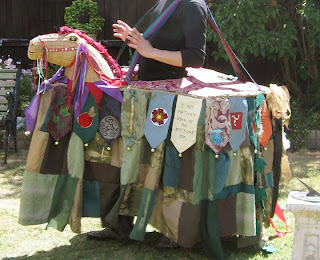
I am putting flags around the sides, not unlike the oss in ‘The Wicker Man’. But instead designs of paint, embroidery or material are going to be added to each one – and I will give these flags to friends to all contribute something. I am using beautiful brocade colour samples I got for free from a curtain store. I cut and sew all the flags to identical sizes. I began to paint 4 flags, beginning with the Isle of Man flag, the ‘triskelion’, with the 3 legs, then I paint a flying raven, a St Andrews flag, and a ivy vine, just to describe a few. I send some pre-sewn flags to friends to begin their designs.

When the ring eventually showed up, I was amazed at its weight, and began to worry. But decided to keep going with it. There is a ring at the front for its head to sit on, and this makes the front heavier. I will have to add a counter-weight at the back; luckily Owen added hooks at the back to tie things to.

I make a tunic and cover this tunic with leaves for a bogie/fool outfit, an accompaniment for the horse, I want follow it with bells, a mask, and a jesters’ hat.

Oct – To make a skirt, I want green material. Terri brings around a variety of left over green material she has accumulated. We cut up squares and rectangles and sew them together making the width of the skirt 6 metres, a little bit over the circumference of the ring. It became a patchwork skirt that had a length of under a metre. It seemed like it took no time at all.

We also cut out the brocade that I wanted the oss to wear – a red and gold colour. I pin the green skirt to the brocade, gathering it every now and then. It is working! I sew the skirt to the brocade.

Painted flags are arriving in the mail from friends – one with a corn dolly attached, one with a boat scene from the Bayeux Tapestry, and one of the Celtic Cross symbol, representing the six symbols from Susan Coopers books, ‘The Dark is Rising Sequence’. I attach bells to the bottom of each flag. One flag was saved for listing the makers of the oss and the names of those who contributed to it, so all could see how much effort was put in.

I have acquired spare braid to attach the flags to. They all fit on the right length of braid and then I pin them into position. Then I sew the flags on, and then it all onto the edge of the skirt.

I sew on the head and make a tail out of scrap material – mostly satin scraps, I added by the tail, my two garden ornament-hanging gargoyles, the Belcher and the Friar, replicas of the outer wall gargoyles of the Brasenose College in Oxford for counterweight.

I buy enough length for straps and when Terri and I attached it, it does not look very strong. We prepare ourselves for possible breakage. However, this Beltane gathering was only one weekend, if we are not happy with anything, we can make it better later on. I find a colour picture of the Mari Llwyd, a midwinter Welsh hobby horse with a real horse skull, and I add it to an oval frame to attach to the skirt. I decide that this picture, looking very feminine, yet very eerie, is named ‘Mary Lloyd’.

‘It was the skeleton of a giant horse, staring with the blind eye-sockets of a skull running and leaping and prancing of legs on bone…faster than any living horse it galloped and without any sound…the creature was playing with them… the leering skull thrust out, the jaws open wide, it charged at them in terrible silence...Bran was sitting up ‘The Mari Llwyd!’ he whispered ‘The Mari Llwyd!’ he was staring at the thing as if bewitched.’

- ‘The Silver on the Tree’

‘The best known skull and pole type of hobby-horse, with glass bottle bottoms for eyes, and a pair of old gloves for ears is the Mari Lwyd, the famous horse of South Wales. He is beautifully decked out with ribbon and horse-bells and appears at midwinter, rearing and plunging in the dark street, while the party accompanying him holds a singing contest with every house they visit…the Mari Lwyd is accompanied by a Sergeant, a Merryman, and a Punch and Judy.’

- Man, Myth and Magic magazine

Version 1.0 of Dobbin - made in 2005

Beltane weekend – On the Saturday of Beltane, Linda asked if the horse could be in ritual, so I then had to gather people for the jester/teasing job. I had my green tunic with leaves, jester hat and ivy mask, Terri was Maid Marion, Hania, Elvanna, Wendy and Emily were jesters and teaser maidens of their own kind, and Ash was the Man-Woman, complete with purple dress and make-up. Lorena led the procession with her daughter Brielle, and they carried a ribboned wreath with bells on a stick. And most important of all, Ryan was our masked Oss rider.

During the ritual the oss was called in. It all happened so quickly, and I barely remember any of it, my main concern was Ryan and the oss, but he indicated when he was ready to leave. The overall reaction to the oss was positive. Everyone loved him, I thought the colours worked extremely well together and the painted flags added to the community effort.

Some damage was done to the oss after the rite – such a dramatic stage pieces should expect a bit of battering – but I plan to make great changes to the oss in the near future, so it will be ready for other festivals!!


One year later.......

In 2006, one year after the making of version 1.0 of Dobbin, I came back with new ideas. I had just spent our winter in England (their summer) and saw all sorts of pagan festivals while I was there, especially the Pagan Pride March in London (held on my birthday!) which had drummers, bogies, Giants, and a Jack-in-the-Green. Such inspiration!

The Oss was far too heavy with his metal ring so we abandoned it for a cane ring. Terri made a fish shaped cane frame which was much lighter, and I took the skirt off the oss. I cut the red and gold brocade to shape and re-gathered the skirt, sewing it back on. As it was a smaller Oss, I chose the best flags to leave onto the braid and sewed that on. I then attached the head with wire this time, and re-attached the tail. All of it was much the same, not as much work was done to this one. The straps were better and the Oss was overall lighter and bounced around a lot better than before.

At the 2006 Mount Franklin Beltane, we all celebrated the 25th Anniversay of the gathering. There were well over one dozen ritualists this year, as we performed a small play and sang a song during ritual. Before the circle was opened, the Oss rider ran around the circle, and our friend Steve was 'Punch' – who had two halves of coconuts and followed the rider – but the rider, in his nervousness, ran too fast and the punch could not keep up!! Dobbin certainly was better this year, lighter and easier to handle.

Dobbin has been used since 2006 at Beltane, but not every year. He quite often comes to Beltane to enjoy the fun, but not always get used. With luck, he will be around for a very long time!!


Version 2.0 of Dobbin - 2006

References

Pegg, Bob. Rites and Riots, Blandford Press, 1981

Folklore, Myths and Legends of Britain, Readers’ Digest Assoc. London. 2nd Ed, 1977

Dalesman Magazine, May 2005

Roberts, Andy. & Clarke, David. Twilight of the Celtic Gods, Blandford Press, 1996

Cooper, Susan. Silver on the Tree, ‘Dark is Rising Sequence’ 1977

Man, Myth and Magic Magazines ‘Hobby-Horse,’ 1971