Heading Message

A Pagan Gathering for Australia and the world

Showing posts with label History. Show all posts

Monday, April 1, 2013

A Paganesque Moveable Feast - Abbots Bromley Horn Dance

A run-down of the pagan gatherings and pagan-like festivals from other parts of the world.

By Tania Poole

Abbots Bromley Horn Dance is believed to have been running since the Barthelmy Fair, granted to the Abbots of Burton by Henry III in 1226, celebrating Bartholomew’s Day – August 24th. The changing of the Julian Calender in 1752 has moved the Fair to the beginning of September, and the Fair became one day, rather than three days. Yet the horns have been dated to centuries before - the 11th century – and being reindeer antlers, they obviously came from Scandinavia, probably down the River Trent and into the Staffordshire region.

The Horn dance day is always held on a Monday – Here is how you remember which day it is on. It’s always ‘the Monday following the first Sunday after the fourth of September’ – remember that folks, many a person has turned up on the wrong Monday and been disappointed…..

So I managed to go to the Abbots Bromley Horn Dance. My friend Steve goes every year, and has done since 1989. So when I thought I could go, I emailed Steve about it, he told me he could not go, but told me how much it was going to cost me to go via public transport. It did not seem worth it, considering if I had to travel there myself, funds were low, and I had plane tickets to buy.  But then Steve changed his mind, saying he would be able to go and help me pay for my travel there. Suddenly that was it – I was going! I also have a new friend that I met only this year. Shamus, an accordion player who plays for the Black Pig Border Morris Team, and is also dating my friend Angela. Shamus has played accordion for the Horn Dancers for over 2 decades now! It's all about who you know!!! 


I met Steve at Wakefield station at 10am, and we made our way south to Derby, then to Uttoxeter where a cab driver was waiting for us – Steve books him every year, so he knows him personally. From there, the village was about a 15 – 20 min drive away.
In Abbots Bromley, you found yourself in a relatively untouched village – a typical Staffordshire village at that – with not much changed. Some of the buildings here still are certainly medieval. We were dropped off at the Buttercross – a hexagonal shaped building near the green that was used for market day over many centuries – I’ve seen one other like it in Bungay. This one is more medieval looking, the Bungay one looks Georgian. Someone there that day told me what a Buttercross was – at market, it was where people bought butter, milk and eggs.
We visited a pagan art stall – a longhaired, bearded attractive man named Chris Bell, selling his pagan art (mostly green men) in the market and I bought a few as gifts for people back home. After that we had our first pint at the Goat’s Head pub, and met some of Steve’s pagan friends there. Great chats with people I’d just met, who had good stories to tell. Even Steve had stories to tell about his annual jaunts to Abbots Bromley. As he’s been coming since 1989, he had a few tales, and I think, could write a book about the goings on that he had witnessed over the years – the pagan camps, the large and small crowds, the popularity of the event, and how they’ve evolved. One story he told was about how he and his pagan friends were sitting in the pub or somewhere and a tradesman came along and asked them about runes – he had seen some around the village – under the tiles of the old roofs and houses – dating back centuries, probably even the middle ages. They had been scratched into the architecture of the old buildings – some of these probably not repaired for many centuries. Sketching the runes for the pagans, the tradesman was told they may have been symbols of protection upon the house. Kind of reminds me of the concealed shoes superstition. Now THAT would be good article.
 
 
After our pint, we went to the old Church House – that is certainly medieval or even later, but definitely one of the oldest houses in the village. They put on a great spread there – sandwiches and cakes to eat, and endless tea – we had our lunch there – well, a small lunch, we also ate more later on.

The Old Church House where we had lunch
 
Steve took me to the St Nicholas Parish Church to see where the horns are kept. I could tell by looking at it, parts of it were Saxon, and like all Saxon churches, had been added to over the years, especially in the Norman times. Saxon and Norman buildings go together a lot here. This one was quite a lovely church. The bars that hang the horns up are there, and even the old hobby horse from years ago – I’ve seen old images from the 70’s of that hobby horse being ridden about the place – it says that the horse is from the Middle Ages – could it actually be that old? I often hold doubt of things like this – what looks medieval, could have been made as recently as the nineteenth century. They use a new one in the dance now. There were also glass cabinets holding the regalia and costumes of horn dancers past.
 
There was also a story from Steve about the pagans who actually came to church services in previous Horn dance weekends, in their velvet robes and pentacles, and sat in the front row, much to the annoyance of the vicar. The Christian locals preferred to sit up the back as far away from the pagans as possible. Would have loved to have seen that.
In the churchyard, the ground surrounding the church was raised, as if it was small pre-Christian mound. It makes us wonder if indeed a Saxon church was here, maybe something before it existed. Steve also showed me a headstone, belonging to a man that was once a leader of the horn dancers – and it says that on his headstone. He belonged to the Fowell family, and they are the official horn dancers – their family and another one are the only members that are allowed to dance, and have been for many, many generations.  Steve also told me about another friend of his and a visitor to the Horn Dance day would spend the night in the graveyard because he had nowhere else to sleep. And people and locals did not mind – he was just the ‘guy who slept in the graveyard.’ Oh Boy! The characters you get at these events.
We walked up the street to the Bagot Arms, passing some of the places where Steve says the dancers stop for a pint, or food. In the Bagot Arms, Steve and I had another pint and we chatted about many other things – pagans in the UK and Australia, folk dancing, horse brasses, and many other things that crossed our minds. I kept seeing more and more people walking past the pub window, as I realised the tourists were arriving. It was probably about 3.00 - 3.30pm by now, and the dancers were due to arrive in the village. After a toilet run, I went outside to find Steve standing there, prompting me along. As I looked west down the road, I saw the dancers skipping along the road with their horns. I got really excited here – this was it! I was finally going to see this horn dance. It all dawned on me where I was when I saw them. I began to not believe that I was here!
As they came along, they circled around each other, and I saw my Staffordshire friend Shamus playing the accordion, who acknowledged me and gave me a head bow. I began to take some short footage of the dance, and Angela, the leader of my border morris team back in Yorkshire, was in the background. She saw me and came around to give me a hug. After this dance the dancers went under an arch and out into the backyard of one of their friends who had put on a bit of food. Steve suggested we walk back into the village, and before we walked off, Ang invited us out the back with the dancers to hang out with Shamus. The four of us got some group photos together and then went further out the back to the lawn to watch some of the dancers dance with some locals. They are a more open folk dance than I thought. You think about Padstow and how only locals can go to the May Day Festival because the tourists ‘clogged the village.’ And the Morris Ring who have men-only sides who refuse to let women join, but here in Abbots Bromley, they let locals dance and WOMEN too! What a nice bunch of people! Not superstitious about a woman holding the horns let alone having a dance!
 

Me with Shamus and Angela, who is the
squire of my morris team


After that, we followed the dancers out to the street again and walked along as we watched them head to the Bagot Arms back towards the village. At this car park, Shamus dragged me over to where the horns were laid on the ground, and shoved a set of horns into my hands. I was holding the lighter horns that were damaged in the mid 70’s and the broken bit was dated to have been from around 1060s. I made sure veteran attendee Steve got to hold them as well.


me with some horns
Steven with the horns
We headed back towards the Buttercross, running into more pagan friends of Steve on the way and stopping for chats. At the Crown Pub, we went inside to see the new décor of the renovated pub – all modern and new, and saw the Horn Dance paintings done in the 1940s. Then we went round the back of the pub and visited the pagan camp site up the back – I saw Nick from the Black Pigs Border Morris and went to say hello to him by his hearse. Then we got a hotdog outside the front of the Crown and then stood with more of Steve’s friends, Cathy and Robin. It was now when the horn dancers had made their way down into the village and arrived outside the Goat’s Head and held up the traffic doing their road-hogging dance. Then they rested by the Goat’s Head and let friends dance with them.


I chatted to friends Ang, Fran, and Shamus, and Steve and his friends joined us. I visited the stalls again and bought some Horn Dancer pins. Then the dancers went out the back of the Goat’s Head and posed for photos. We stayed back there in the large beer garden until about 6pm, then headed back to the Crown. It was time for Steve and I to get back to the station, so we looked for our cab. I could not find Ang or Shamus at all, so never got to say goodbye. It was the last time I saw Shamus too. Our cab was waiting when it started to rain again. We got the train from Uttoxeter to Derby and then caught one home to Leeds - finally on our separate ways home, and with a few train cancellation issues, Steve and I made it safely home.
 
I had an awesome and memorable day at Abbots Bromley and am very glad I got to go. It was magic! And brilliant to witness such an old dance and finally see how it was conducted, especially since I have been going to folk dances all year. Getting to know so many people apart from Steve in England has been wonderful, meeting Shamus in March and becoming friends with him, and then learning that he was the accordion player for the Horn Dancers absolutely blew my mind! What are the chances of such a meeting! I had such a wonderful day!
Even now, after six months, I am still reeling from the experience. I had always dreamed of going, and never thought I actually would! Thanks to Steve Jones, Shamus O'Blivion, and Angela Boycott-Garnett.


Tuesday, October 4, 2011

A Maypole History

Any British folklorist out there have usually read the history of the maypole, and indeed even pagans usually like to read about the history of the festivals they love to celebrate. Most of the information here may be knowledge that a lot of people already know, but as the maypole is a large feature of the Mount Franklin Annual Pagan Gathering, it’s a good idea to write about maypole history, just in case someone out there doesn’t know.

According to J. G Frazer, it all starts with the worshipping of trees. Centuries ago, Europe and Britain were covered in forests, gradually being cut back with the growth of human population. Many countries that were covered with forests had human inhabitants that respected the tree. In Germany, tree worship is still evident today. To damage a tree was death to the criminal. Sacred groves and copses were regarded as divine and holy, and to kill or damage a tree was like killing a human. It was believed that trees cried out in pain when cut or damaged, thus in felling a tree, you must first ask its pardon – pagans still do this today.

As trees were a symbol of fertility, the trees were worshipped by women who desired to be mothers. This occurred in the East as well as Europe – the maypole supposedly possessed similar powers over both women and cattle. During the late spring and summer months, maypoles were cut from the forest and blossoming branches were strung around the house entrances. The reason for this was that the people welcomed the blessings of the tree-spirit and its power.

According to C.A Burland, it is linked to phallic worship. The maypole represented the phallus of the fertility god. This is why the maypole is surrounded by dancing couples, and why May Day festivities are associated with couple love-making in the forests overnight. Burland suggests that it is possible that the maypole, as a phallic symbol, came over from Europe with the Anglo-Saxons. Ronald Hutton mentions that the Saxons worshipped the pillar Irminsul, but there is no evidence that the maypole was a reflection of it.

According to Kondratiev, the maypole is linked to the Hawthorn Giant’s role as fertiliser of Fomorian nature – a cut tree is the ‘castration’ of the Giant, without the loss of potency – and revered in the Celtic tribes. Its magic is passed on to those who dance around it. Cerne Abbas, the hill giant of Dorset, is also supposedly connected to this phallic worship, as was many standing stones.

According to Cooper, the maypole goes back to the Phrygian pine tree of Attis, taken in procession to the temple of Cybele, coming from Rome into Europe, then Britain. Hutton says that Hobbes declared the maypole a relic of the Roman God Priapus. There is no documented evidence of maypoles in Britain until the Middle Ages, and even then, there may have been some around during the Anglo-Saxon times.

Whatever theories Frazer, Burland, Kondratiev and Cooper have, today May Day is all about green boughs, blossoms, branches of hawthorn and other greenery bordering doorways and shrines, and the maypole itself. It almost does not matter what origin the maypole was. The May Queen is usually seen parading with maypoles – her retinue of girls often carrying small maypoles garlanded with flowers. Maypoles were decorated each spring, on display on the village green all year, in some villages on May Day it was replaced. Each village, country and people had its own annual tradition of maypole celebration. The maypole was often the target of raids by rival villages – people seemed to know how to strike at the heart of other people. In the 1500s, maypoles were well documented in Britain. In 1644, the Puritans passed an Act of Parliament and banned the maypole and the festivities surrounding it, and there was no dancing around the pole of village greens until the Restoration era of Charles II in the 1660s. Towards the end of the 1700s, the village maypoles were often abandoned, left to rot, blown down, not replaced, or standing disused upon the green. They fell out of fashion. Eventually, maypoles and May Day festivities returned in the Victorian era, when people began to romanticise the older days. People also may have needed merry-making and festival when the Industrial Revolution took them away from the country villages, summer celebrations and the happiness of human revelry. The use of ribbons on the maypole came in the 1800s from Europe and the Mediterranean.

On the Eve of St John (Midsummer) in Stockholm, thousands
of maypoles from 6 inches to 12 foot high decorated with leaves,
flowers, slips of coloured paper, gilt egg shells strung on
reeds are for sale. This pole consisted of a straight and tall spruce-pine
tree, stripped of its branches. Hoops and wood placed crosswise are
attached to it and decorated with foliage and ribbons.

The largest maypole in London stood at 134 feet high in the Strand, in the 1660s to celebrate the return of the Monarchy. Today, England’s largest maypole is in the village of Barwick-in-Elmet, standing at 86 feet tall and is the tallest permanent maypole in England, since around 1829. It is only taken down to be repainted and renovated. Four garlands are made by different communities in the village. Each garland consists of around 2,000 silk rosettes and 48 red, white and blue ribbons, with bells. This maypole is not used for ribbon dancing because of its height, and that it is so close to buildings. Instead, the children of the village use a smaller maypole to dance around. It takes three hours and 150 men to erect the large maypole.

While the Mount Franklin Pagan Gathering is 30 this year, its maypole is younger than that, believed to be 20+ years old. A bicycle wheel adorns the top and green and red ribbons - 8 each – are unravelled just before the pagans dance with it again. Every Sunday morning at Mount Franklin Beltane, before the pole is erected, the bicycle wheel is covered with Hawthorn blossoms (if it’s flowering) and pink roses (if they’re flowering) from the Mountain side.

Since 2004, the maypole song from ‘The Wicker Man’ has been sung during the dance. Often, afterwards, depending on the success of the dance and the pattern of the ribbons, someone with the talent foretells the future 12 months, from the pattern the ribbons made. Whatever the maypoles history, we want this tradition to continue at MFAPG, and I am certain most of you will agree.

Books referred to:

Alexander, Marc. ‘A Companion to the Folklore, Myths and Customs of Britain’, Sutton Publishing Ltd, 2002.

Bord, Janet & Colin. ‘Dictionary of Earth Mysteries’, Thorsons, 1996.

Burland. C.A. ‘Echoes of Magic: A Study of Seasonal Festivals through the Ages’, Peter Davies, 1972

Cooper, J. C. ‘The Dictionary of Festivals’, Aquarian Press, 1990

Dalesman Magazines – March 1999 & April 1996

Frazer, J.G. ‘The Golden Bough’, Macmillon Press, 1922.

Hutton, Ronald. ‘The Rise and Fall of Merry England’, Oxford University Press, 1994.

Hutton, Ronald. ‘Stations of the Sun’, Oxford University Press, 1996.

Judge, Roy. ‘The Jack-In-The-Green’, The Folklore Society, 1979.

Kondratiev, Alexei. ‘The Apple Branch: A Path to Celtic Ritual’, Collins Press, 1998.

Matthews, John. ‘The Summer Solstice’, Godsfield Press, 2002.

Pegg, Bob. ‘Rites and Riots’, Blandford Press, 1981.

Tuesday, September 13, 2011

The Green Man


My Yorkshire-born mother collects the Dalesman magazine, an A5-sized magazine about the Yorkshire Dales - and she has been getting a subscription for many decades. Indeed, I have found many awesome gems in the mags regarding pagan history, myths, English folkloric festivals (maypole and hobby horses) and legends - all from rural Yorkshire. Its a great magazine, I've cited them in articles and blog posts, and enjoy flipping through them when I visit Mum and Dad.

Here is an article about the Green Man that appeared in the latest issue that arrived -

(for those who don't know, Wharram Percy is a deserted medieval village (the most famous one in England and an archaeologists dream) with only a church left, and remains of old allotments of land only visable from the air!)

The Green Man (article from August 2011 Dalesman)

It is a curiosity that the head and face of what many interpret to be an important pagan deity appears with such frequency in Christian churches – and not only throughout Britain, but in Europe and beyond. And in the UK, of course, the so called Green Man appears on many inn and pub signs. The Green Man sign currently handing outside the hostelry and hotel in the Market Square of Malton is a variant on the others because the chap depicted there is someone pretty closely related to the idea of the legendary Robin Hood, Squire of Loxley.

So who was the original Green Man? Well, he appears to have been some sort of spirit or fertility figure, symbolising re-birth. He is both full of vitality and virility. Vines and green leaves and other vegetation adorn his head, sprout from his eyes and ears, and wreath his temples. He sometimes pokes out his tongues, and he often has cat-like ears.

And, let us not forget, early Christians would often “convert” earlier gods to their own cause, and sometimes even made them into saints. Druids worshipped a man of the forests, and particularly the spirits of the oak trees. He goes back into the mists of time (oddly, he’s always a male, never female – despite connections to Mother Earth). One of the most important Roman finds in Britain, the Mildenhall Hoard, has a huge silver salver as one of its major pieces, and there, in the centre, is the raised face of a Green Man.

Jack in the Green (who figures largely in many May Day festivities), John Barleycorn, Puck and Robin Goodfellow all have elements of the Green Man about them, and even cheerful old Santa (as illustrated in early Victorian drawings) is a holly-wreathed bucolic gent with a zest for life.

Since Yorkshire is the largest county in England, it won’t come as any surprise to readers to find that we lead the rest in Green Men dotted about in our churches and monastic ruins. There are carvings of Green Men in Fountains Abbey, in Pickering, Pocklington and on the ruins of the church in the lost village of Wharram Percy.

You can spot them in stone in Ripon and Rudstone, and in Burton Agnes, Bridlington, Bishop Burton and Beverley Minster. Learned researchers have tracked down at least 120 Green Men in the east of the country and in Ryedale alone, and they turn up on pews, columns, chairs, fonts and pulpits. That’s something of a record. Sadly, a particularly fine lectern in the church at Burton Agnes, with no less than four Green Men carved into its ancient surface, was stolen – and hasn’t been seen since. So much for leaving churches unlocked and open for the curious to view with interest and reverence.

Pubs with the Green Man name are, oddly, far more rare. Apart from our chum in Malton, there’s another on Otley Road in Bradford and one (apparently now closed) in Hull, and there, unless readers know otherwise (which you frequently do), we are.

In Malton the Green Man is a late Georgian-looking building, typical of market towns of the day. It is white-washed, and has been altered slightly with fairly recent dormer windows. Malton Ladies’ Luncheon Club used to meet here until their numbers grew to be rather more than the dining room could hold, and now the ladies meet monthly in nearby Pickering.

The sign (at present) is a little tired and careworn, and needs a sympathetic refreshment. Let’s hope that is in the pipeline. And what, since you ask, is the pub at Doncaster’s very own Robin Hood Airport called. Could they have called it the Robin of Loxley, or the Green Man? Erm, no. With a singular lack of imagination, they’ve called it … The Amy Johnson. And what has the late lovely aviatrix got to do with Doncaster? In a word, nowt. But then, that’s the naming of pubs for you..

Thursday, February 24, 2011

The Aboriginal Reserve near Mount Franklin

Warning for Aboriginals: this article may contain images and views of deceased people.

There was an Aboriginal reserve around Mount Franklin in the 19th century. Between 1852 and 1864 two Aboriginal families farmed on a 21 acres near Mount Franklin.The families farmed a section of the Aboriginal reserve, formally the Loddon Protectorate established by Edward Stone Parker in 1841.

This was an organised system that helped displaced native people from tribes of the area to run their own farm under Parker, who provided services of magistrate and guardian. Parker gave employment to the native people in pastoral and agricultural care, as he understood that they had lost their traditional way of life and thus he encouraged that they adopt a European lifestyle.

These Aborigines belonged to the local Jaara or Jajowurrung tribe, whose numbers had diminshed greatly since the 1830s. Parker’s intentions were as good as any respectful albeit ignorant colonial settler, however there is little record of the feelings of the Aborigines – one reported that he did not like Europeans or their customs, yet had no choice but to adopt that lifestyle.

Farm of Aboriginals near Mount Franklin

Eventually as the people of these tribes disappeared - dying of diseases or murdered, the reserve was closed and the two families amoung others were moved to an area near Healesville.

It appeared E.S Parker made a great attempt at saving the native people by civilising them in this area, but that is very difficult to do when the native people lived so differently to the White settlers, who just boast about their civilised ways. There has been verbal debate and rumours about the possibility of a more brutal destruction of the native people in the area of Mount Franklin and Franklinford, but I personally am not sure of such documented fact, nor knowledgeable of any citations regarding that kind of information.

Other details of this history are mentioned in the October 16th 2010 blog post 'A History of Mount Franklin'
http://mountfranklinannualpagangathering.blogspot.com/2010/10/history-of-mt-franklin.html

Today, we respect the land and their tribes, and thank them for allowing our presence on such sacred ground. The Celtic Heritage Society have always been respectful of elders, tribe members and their ancestors when conducting their own ancestral and traditional ceremonies upon this land. Both the ethnical peoples ancestral ceremonies are not so different when you look deeper into them…


References:

Reilly, Dianne. & Jennifer Carew, ‘Sun Pictures of Victoria: The Fauchery-Daintree Collection – 1858.’ Currey O’Neil Ross – The Library Council of Victoria, 1983


Friday, December 17, 2010

Photo from 2006

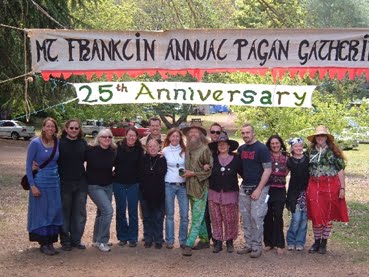
Here is a picture of the Celtic Heritage Society and friends at the Mt Franklin Beltane 25th Anniversary.

Thursday, November 25, 2010

'Join the Ritual..!' - my experiences of Beltane since 1999, and lending a helping hand...

About 64 hours before I arrived at the 2010 Mount Franklin Beltane, I was standing on Glastonbury Tor, looking over the land on a wet Autumn day, thinking about how I would be at our precious Mount in a few short days. It will be my 11th attendance at the Annual event. I recall the earlier days of my first few Beltane’s. My first one was in 1999, at the age of 22, a friend and I went up on the Saturday afternoon.

My friend had written to the Celtic Heritage Society and gained details of the event. It had rained that day, and when we arrived, I remember seeing the Mount for the first time – topped with a cloud. In the crater, the clouds touched the top of the pine trees, making a haunting canopy – it felt like the cloud protected us rather that rained on us – it had stopped raining that time anyway.

As we drove around the campsite, we began to get really excited, as we saw people dressed wonderfully. I recall seeing a grey-bearded man wearing real antlers and people robed ready for the rite. I even ran into friends of mine from my home town, so did not feel so lonely. It was thrilling for the first time – such a magical mysterious innocent time for me! In reality, it was my first public pagan gathering, a time I wish I could relive.

Over the years, I took up more and more friends and by 2002, there was a large group of us – the Geelong and Ballarat Pagans in the Pub group camped together. One year later in 2003, my friend Ryan and I began to paint banners a few weeks before the event, to decorate our campsite – and simply because we were creative and loved painting on calico. We also painted on a marquee we planned to bring up too. For some reason (that I am still unsure of) people - mostly previous friends - appeared to envy our banners and flags at Beltane – I don’t know why, I was trying to be creative and colourful, with no other intention, but maybe to encourage others to do the same. Most people loved it, others apparently didn’t. It was my first unusual taste of criticism at Beltane – a place where I thought that sort of thing would not come up! Three weeks before the 2003 Beltane, I got a call from a friend asking me if the Geelong Pagans would like to do the ritual this year. The organisers had asked her to ask us – I panicked but said yes and rallied our friends to help out. Ryan and I wrote the ritual and I volunteered to be High Priestess (much to my nervousness!) a role I thought I would not take so soon in my life.

Over those 3 weeks we made costumes and tools for the rite. All went well until I got sick probably from the stress and nervousness – sick or not, on the day I was as ready as I could be! I even have a photo of myself just before ritual that has a strange ghostly cloud over it!


The ritual went well – the previous year (2002) the ritual consisted of a group of maidens (me one of them) who danced the circle, and then a masked Horned God entered and chased the maidens – choosing one for his bride.

We loved it so much, we wrote an opposite version – we had a masked Jack-In-The-Green dance around the fire. Some playful maidens came into the ritual to tease our Jack and chase him, until the Goddess came in and banged on her tambourine, silencing and dismissing the maidens. She kissed the Jack and they circled the ritual, being bowed to by those in the circle, then they left for the woods. It ended up being a success, despite my stress and illness, and even a few things we forgot for the rite, but got just in time!

I was glad to get the chance to do it. Every year since then, I have been involved in the ritual in some form. In 2004, I chose the God and Goddess for the ritual, and led the Spiral Dance.

In 2005 I had made an ‘Obby Oss’ for the ritual, which was an amazing feature for that year (I’ll be writing a post about the Oss soon).

In 2006, being the 25th Beltane, the ritual had its largest number of participants – some 15+ ritualists involved, all masked and hauntingly mysterious. Those were some of my favourite years. It’s been so long!

The 2007 Beltane was very crowded – all sorts of people turned up for the ritual – hundreds more than we expected – because people had been using the internet to advertise it, and the mount is too small for such a large number. So in 2008 the event was invite only and what a wonderful event it turned out to be, the ritual ran by Ásatrú friends of mine!

In 2009, I missed my first Beltane since the 90’s when I worked at another event nearby for the weekend – due to unwanted politics that was new at the event; I decided to take a year off!

2010 – this event was very wet, but was back to its old mischievous self – When I arrived at Mount Franklin at 5pm on the Friday, I had not even been in the country for 24 hours yet – I had landed at Tullamarine near midnight the night before, having travelled back from a 2 week trip to the UK. On the Monday to Wednesday that week, I was in lovely Glastonbury, the pagan Mecca for travellers on a pilgrimage in the UK. On Wed and Thurs I flew home and Friday arrived at the Mount to sleep in my car and did not feel any jetlag! The 2010 event was wonderful, the Celtic Heritage Society campsite had a lot of supportive friends and the weekend was rather problem free for us – giving us ample confidence to plan the 2011 event that will be the 30th Beltane!

Already we have a large interest from old friends who are returning, and will make it a special event – and a special anniversary ritual! Don’t forget to write to the correct address for an invitation!

Tania Poole

The antlers made for the 2003 Beltane Jack-in-the-Green


Friends at the 2003 Beltane


The God and Goddess from 2004 Beltane - Craig and Elva

Wednesday, November 17, 2010

My Beltane People

When I agreed to help initiate this weblog I had spent a pleasant afternoon chatting with Linda and Michel about the old days at Mount Franklin and, inevitably, the talk turned to people of Beltanes past. Beltane has always been about people and regardless of whether you attend one or twenty-nine, it becomes a part of you and you indelibly become a pert of it too. I have brought many friends to Beltane, my sister Susan was handfasted at Mount Franklin and a swarm of friends came to share in it. When I see these (non-pagan) friends now, years later, they still remember their Beltane and the people that they met there.


Some, like my sister, are no longer with us, and Beltane has missed the contributions of David O’Conner (remember his fire walking?) or Simon Goodman who guided the organizers in the early years. One who I particularly miss is Leon, the country boy from Gordon who was the most natural-born pagan that I have ever met. Leon was the first to jump up for a job that needed doing and the last to leave when the clean-up crew were done. I miss him at the mountain and I am sad that I won’t hear him growl a greeting at me again (in this life).

Others have drifted away, like Gary Trevers who loved the music of the weekend. I also miss seeing Jerry & Carol who have wandered away now but were once regular and enthusiastic attendees. And, over the years, there have been those who have drifted through and gone, taking something of the Beltane spirit with them. There was Michael Jackson (I kid you not!) who helped me to spit roast a goat for the handfasting feast. That same year, Susan’s friend Dave Munday burned his bum on the bonfire, after the main ceremony, trying to jump it after Linda told him that it would increase his virility!

But, I think that the most memorable character for me was the Lady Tanith who flew to Victoria from Perth one year for the weekend. She was a grand old dame and, I am sure, a fine witch. We escorted her (and her po-mouthed assistant) to and from Mount Franklin, ran her errands and generally indulged her for four days and, as she left, she gave me a very generous gift of Frankincense oil (which Cazz may still have! Ha Ha!). She was great fun- and a real character too, and I always hoped that she remembered her Beltane at Mount Franklin with affection.

by David Mattichak

Tuesday, November 9, 2010

A New Thread in an Old Tapestry

As this site has so many active followers and has garnered some small amount of interest among Pagans around the world (yes folks, the world has been watching!) I thought that it may be constructive to begin a thread where we can all make a positive contribution. I would love to hear what all of you like most about Beltane, and other celebrations, at Mt. Franklin. What do you think are the essential events of the Beltane gathering? What kind of ceremony should there be? What elements of the ritual are the most vital, exciting, meaningful to you? What direction do you think that the Beltane celebrations should go in from here?


Leave a comment here or e-mail us at mountfranklinpagans@gmail.com and we'll get it posted for you.

Monday, November 8, 2010

Looking towards 2011 and the 30th Anniversary of Mount Franklin Annual Pagan Gatherings!!

Well, what can we say the excitement is already upon us as we stir the pot and conceive of some wonderful and innovative ideas for next years 30th anniversary! One of the ways in which we have decided to celebrate the unique place that the gathering holds in so many hearts is to expand this blog site to include great articles from both Traditional and Pagan streams of Craft. Here we hope that readers and followers of this blog will enjoy both contributing and indulging in information which is unique to the practices found in Australia.

Housekeeping!:
No inappropriate material will be permitted on this blog site. Any further inflammatory postings by persons indulging in pointless illogical attacks will be removed post haste. This is not the forum for your particular angsts either real or imagined.

What we do welcome is educated articles regarding Craft and Paganism, books, memories and discussions. If any out there are hogging those special Mount Franklin memories somewhere in pictorial form or deep in the cerebral vaults then please,  by all means dig them out, extract them and send them in for publishing!

That said, it is time to move forward. It is time for rising above that which would seek to bind us. Light well your lanterns! Proceed with all due care to illuminate the winding path,  the long walk that leads us home.

Blessed Be

Mods.

Cool Pic from 2002!

This photo of that appears to be hooded spirits was taken on the last Saturday of October in 2002, by my friends’ friend. It was a digital camera, and the picture appeared fine until it was uploaded, and appeared like this. This picture has not been doctored at all.
The location is campsite called Mt Franklin, a very beautiful volcanic crater in central Victoria near Daylesford, where an annual pagan ritual has occurred. At the time this picture was taken, the festival was in its 21st year. The picture faces the actual ritual site used every year. Other rituals are held by pagans in this campsite, all year round, but none as large as this annual event. This was taken the morning before the ritual. It’s a very sacred place to pagans of Victoria.

I have even had a strange mist appear before me in a photo at the mountain just before I was actually going to run the ritual as priestess, this occurring in 2003. Over the years other people have seen strange things – children-sized little people sitting cross-legged on tent roofs, and aboriginals ancestors watching over the gatherings. I also saw a child/faery in a tree for a split second as I was driving out of the mountain in 2002, only a few hours after this amazing photo had been taken.

I am not sure the picture can be enlarged any more than this.

TANIA